
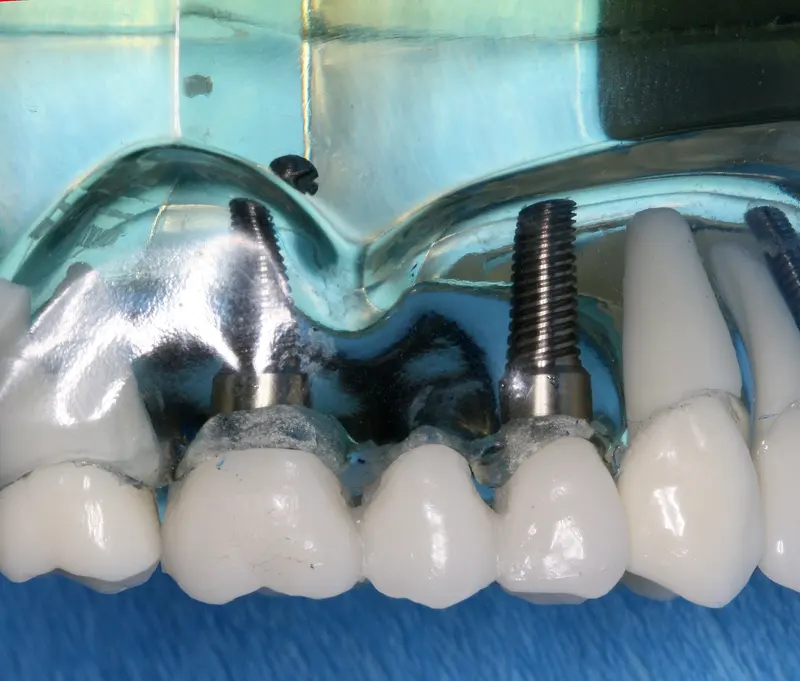
About bridges
A bridge replaces one or a small number of missing teeth with a false tooth that is fixed in place - unlike a denture, you cannot take it out. It is supported by the natural teeth (or implants) either side of the gap.
A conventional bridge uses crowns on the neighbouring teeth to hold the false tooth, so those teeth have to be cut down. A resin-bonded (adhesive) bridge uses small metal 'wings' glued to the back of a neighbouring tooth and usually needs little or no drilling; it is mainly used for single teeth, often at the front of the mouth.
A bridge is only suitable when the supporting teeth are strong and healthy and there is good bone and gum support. Replacing the gap can stop neighbouring teeth drifting, keep the bite balanced and help you chew and speak comfortably.
How it works
- Assessment, usually with X-rays, to check the supporting teeth
- For a conventional bridge, the teeth next to the gap are shaped and a temporary bridge fitted
- Moulds or scans are sent to a dental laboratory, and the colour is matched
- The bridge is tried in and cemented into place, and the bite adjusted
- For a resin-bonded bridge, there is usually little or no drilling and the wing is bonded behind a neighbouring tooth
Time, lifespan and cost
- Time needed
- Bristol Dental School says a conventional bridge takes 2 to 3 visits, and a resin-bonded bridge 2 to 3 appointments of 1 to 2 hours. If a tooth has just been removed, the gum usually needs around six months to heal first.
- How long it lasts
- Bristol Dental School says a conventional bridge can last over 10 years if looked after well; resin-bonded bridges can debond and sometimes be re-cemented.
- On the NHS?
- Available on the NHS. Bridges are a Band 3 NHS treatment in England (£332.10 from 1 April 2026) unless you are exempt, where clinically appropriate. Ask your dentist which designs and materials are available on the NHS. NHS charges
Private cost
From £675 to from £1,449 per unit
Bridge from £675 per unit (Bupa Dental Care Brigg); porcelain-bonded bridge from £1,449 per unit (Bupa Dental Care London Bank). A bridge usually involves more than one unit.
Published starting prices from individual practice price lists, checked September 2026. These are not averages and your quote could be higher. Sources: Bupa Dental Care Brigg: Treatment prices, Bupa Dental Care London Bank: Treatment prices.
The cost depends on the type of bridge, the number of teeth involved and the materials used, so we do not quote a typical price. Always ask for a written treatment plan and a clear estimate before starting. (Source: Oral Health Foundation: Bridges)
Pros and cons
Pros
- Fixed - no need to remove it
- Restores appearance, chewing and speech
- Stops neighbouring teeth drifting into the gap
- Resin-bonded bridges are minimally invasive and reversible
- Conventional bridges can last over 10 years with good care
Cons
- Conventional bridges involve irreversible cutting of healthy neighbouring teeth
- Resin-bonded bridges can come unstuck and usually replace only one tooth
- Special cleaning is needed under the false tooth
- Needs healthy supporting teeth - not suitable for everyone
- Gum usually needs to heal first after an extraction - often around six months
Aftercare
- Clean under the false tooth every day with special floss or other cleaning aids your hygienist recommends
- Brush twice a day for 2 minutes with fluoride toothpaste
- If a resin-bonded bridge comes off, keep it and contact your dentist - it may be re-cemented
- Attend regular check-ups to keep the supporting teeth healthy
Risks and side effects
- Nerve damage in a prepared supporting tooth - Bristol Dental School estimates roughly a 20% chance - needing root canal treatment or extraction
- Resin-bonded bridges debonding
- Porcelain fracture
- Decay or gum disease around the supporting teeth
- Bridge edges becoming visible if gums recede
Your dentist should explain the risks that apply to you before you agree to treatment.
Problems it can help with
Gaps between teeth can be harmless, a sign of missing teeth, or occasionally a sign of gum disease. How to tell and what can close them.
An adult tooth knocked out can often be saved if you act within the hour. Step-by-step first aid, plus what happens at the dentist.
Gaps from lost teeth can affect eating, speech and confidence. Compare dentures, bridges and implants, and why the gap itself matters.
Compare it with the alternatives
Implants vs bridges vs dentures
The three main ways to replace missing teeth compared: fixed or removable, effect on other teeth, treatment…
Common questions
Bridge or implant?
It depends on the health of the neighbouring teeth and your jawbone, the number of missing teeth and your budget. See our comparison of implants, bridges and dentures.
Can I have a bridge straight after an extraction?
Usually not. The Oral Health Foundation says the gum often needs about six months to heal, and you may be offered a temporary option meanwhile.
How do I clean under a bridge?
Your dentist or hygienist will show you - usually with special floss or small brushes that can pass under the false tooth.
Useful at home
Products that can help with day-to-day care alongside this treatment. Ask your dental team what suits you. Some links may be affiliate links.
TePe Bridge & Implant Floss
Pre-cut spongy floss with stiff ends that thread under wires, bridges and around implants – handy for anyone with fixed braces.
TePe Interdental Brush Original (mixed pack)
Classic straight interdental brushes in colour-coded sizes. A mixed pack is a practical way to find which sizes suit your gaps –…
Waterpik Cordless Advanced water flosser
A rechargeable, cordless water flosser that is easier to store and travel with than a countertop unit, at the cost of a smaller…
Waterpik Ultra Professional countertop water flosser
Waterpik's countertop model with the widest range of settings and tips. A water flosser can make cleaning around braces, bridges…
Sources we used
- Oral Health Foundation: Bridges
- Bristol Dental School: Conventional dental bridges
- Bristol Dental School: Resin-bonded bridges
- NHS: Dental treatments
- NHS: How much NHS dental treatment costs
- NHS dental charges from 1 April 2026 (poster, PDF)
- Bupa Dental Care Brigg: Treatment prices
- Bupa Dental Care London Bank: Treatment prices
Checked September 2026. Guidance changes, so always follow the advice of your own dental team. About our sources.