
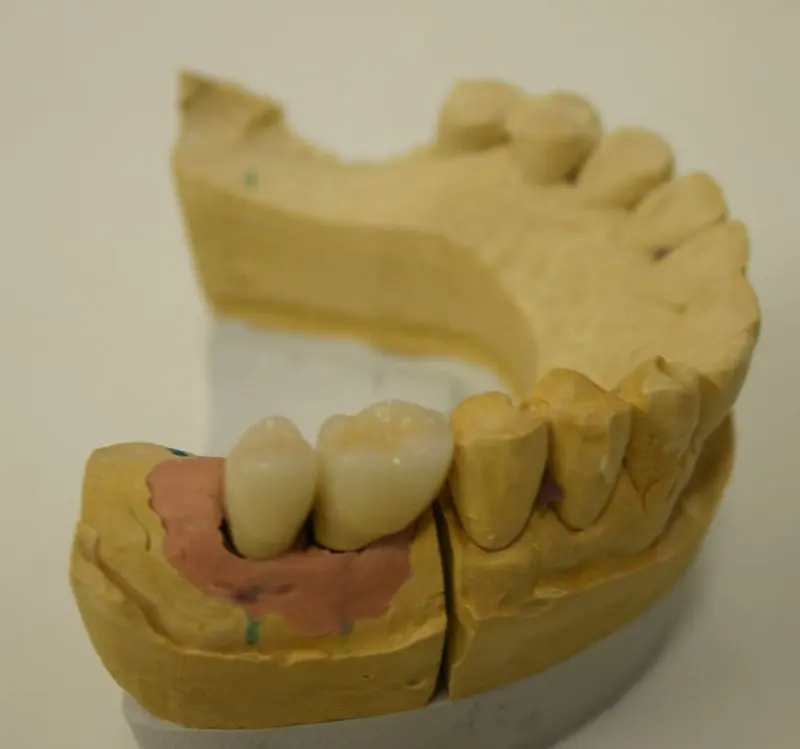
About crowns
A crown is a cover that fits over the whole of a prepared tooth, restoring its shape, strength and appearance. Crowns are fixed in place and act much like a natural tooth.
They are commonly recommended when a tooth is badly broken or decayed, has a large filling that needs protecting, has had root canal treatment, or is worn or cracked. They can also improve a discoloured or misshapen tooth, and they are used to support bridges.
Crowns can be made from porcelain bonded to metal, all-porcelain, gold alloys or other ceramics. Porcelain crowns look very natural but may be less strong; gold is very durable and used mainly on back teeth. On the NHS you may be offered a metal-coloured crown on a back tooth.
How it works
- First visit: the tooth is numbed and shaped to make room for the crown
- Moulds or digital scans are taken and the colour is chosen
- A temporary crown protects the tooth while the laboratory makes the permanent one - typically 2 to 4 weeks
- Second visit: the temporary is removed, the new crown is checked for fit and appearance, and it is cemented in place
- If a tooth is badly broken but the root is strong, a post may be placed in the root to hold the crown
- Some ceramic crowns can be designed by computer and fitted on the same day
Time, lifespan and cost
- Time needed
- Usually two appointments; Bristol Dental School says they can be up to 3 hours each, with 2 to 4 weeks between them. Same-day ceramic crowns are available at some practices.
- How long it lasts
- Crowns can last many years if well cared for; the NHS notes they may need replacing in the future. Your dentist can estimate how long yours is likely to last.
- On the NHS?
- Available on the NHS. Crowns are a Band 3 NHS treatment in England (£332.10 from 1 April 2026) unless you are exempt. You may be offered a metal-coloured crown on a back tooth; your dentist can explain private alternatives, their risks, benefits and costs. NHS charges
Private cost
From £668 per crown
From £668 (Bupa Dental Care Brigg). Other practices checked quoted crowns only after consultation.
Published starting prices from individual practice price lists, checked September 2026. These are not averages and your quote could be higher. Sources: Bupa Dental Care Brigg: Treatment prices.
Private fees vary widely between practices and depend on the complexity of your case and the materials used, so we do not quote a typical price. Always ask for a written treatment plan with costs before you agree to treatment. (Source: NHS: How much NHS dental treatment costs)
Pros and cons
Pros
- Restores function and appearance of badly damaged teeth
- Reinforces heavily filled or root-treated teeth
- Fixed in place and behaves like a natural tooth
- Can last many years with good care
Cons
- The tooth has to be cut down, which is irreversible
- Usually needs two visits and a temporary crown
- Porcelain can chip or fracture
- Gums can recede over time, exposing the crown edge
Aftercare
- Treat temporary crowns gently - they are not as strong as the final crown
- Brush twice a day with fluoride toothpaste and clean between teeth daily, including around the crown edge
- Avoid biting hard objects such as ice
- Attend regular check-ups
Risks and side effects
- The nerve of the tooth may become inflamed and die - Bristol Dental School puts the risk at roughly 20% - needing root canal treatment or extraction
- Gum recession exposing the crown margin
- Porcelain fracture requiring replacement
- Temporary crowns breaking or coming off
Your dentist should explain the risks that apply to you before you agree to treatment.
Problems it can help with
A tooth that has broken badly - especially after an accident - needs prompt dental care. What to do right now and what treatment may follow.
A small piece has broken off a tooth. Usually not serious, but worth getting checked. What to do now and how dentists repair chips.
Pain when biting, or twinges with hot and cold, can mean a cracked tooth. Cracks cannot heal on their own, so early treatment matters.
A build-up of pus from an infection in a tooth or gum. It will not go away on its own and needs urgent dental treatment.
A filling has fallen out, cracked or feels loose. How to protect the tooth until you are seen and what a dentist might do next.
Teeth darken with age, tea, coffee, red wine and smoking. What professional cleaning, whitening and other options can - and can't - do.
Grinding or clenching - often at night - can wear teeth, crack fillings and cause jaw pain and headaches. Causes, self-help and night…
Decay often starts silently and ends in holes, pain or infection. How it develops, the early warning signs and the treatments at each stage.
Teeth that look shorter, thinner, more yellow or sensitive may be wearing away. Find out the causes - acid, grinding, brushing - and fixes.
Compare it with the alternatives
Crowns vs veneers
Full-coverage crowns and front-surface veneers compared: what each fixes, how much tooth is removed…
Common questions
Can I have a white crown on the NHS?
The NHS says you may be offered a metal-coloured crown on a back tooth, and your dentist should discuss private alternatives with you.
Do root-treated teeth always need a crown?
Not always. After root canal treatment a tooth can become more brittle, and your dentist may recommend a crown if a filling would not be strong enough.
What is a post crown?
When a tooth is badly broken but the root is strong, a small post can be fixed inside the root and the crown attached to it.
Sources we used
- Oral Health Foundation: Crowns
- Bristol Dental School: Dental crowns
- NHS: Dental treatments
- NHS: How much NHS dental treatment costs
- NHS dental charges from 1 April 2026 (poster, PDF)
- Oral Health Foundation: Root canal treatment
- Bupa Dental Care Brigg: Treatment prices
Checked September 2026. Guidance changes, so always follow the advice of your own dental team. About our sources.