
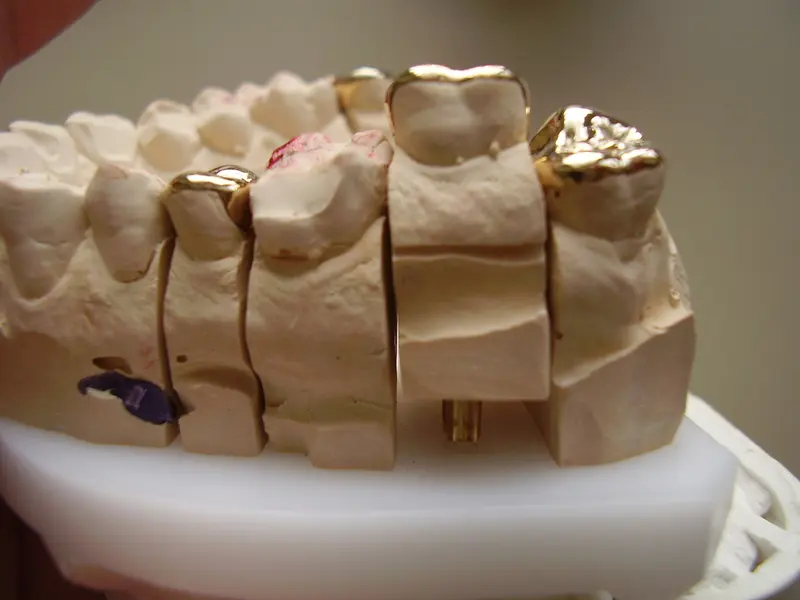
About inlays and onlays
Inlays and onlays are like fillings, but they are made outside the mouth in a dental laboratory and then cemented to the tooth. An inlay fills a cavity within the tooth; an onlay is usually larger and covers the biting surface.
They are used when a tooth has been damaged, an old filling is no longer doing its job, or the tooth needs more protection than an ordinary filling can give. Bristol Dental School notes they recreate the bite more accurately than a direct filling and remove less natural tooth than a crown.
They can be made from gold or other metals, porcelain or composite. Tooth-coloured versions can match the tooth well, while metal ones will not.
How it works
- First visit: the tooth is numbed, damaged tooth or old filling is removed, and a mould or scan is taken
- A temporary filling protects the tooth while the laboratory makes the inlay or onlay
- Second visit: the temporary is removed and the inlay or onlay is tried in to check the fit
- It is cemented with a strong cement, then the bite is checked and it is polished
Time, lifespan and cost
- Time needed
- Typically two appointments, with a temporary filling in between while the laboratory makes the restoration.
- How long it lasts
- Bristol Dental School says inlays and onlays can last 15 to 20 years if looked after well.
- On the NHS?
- Available on the NHS. Inlays and onlays are listed as Band 3 NHS treatments in England (£332.10 from 1 April 2026) when clinically necessary, unless you are exempt. Ask your dentist which materials are available on the NHS and which would be private. NHS charges
Private cost
Private fees vary widely between practices and depend on the complexity of your case and the materials used, so we do not quote a typical price. Always ask for a written treatment plan with costs before you agree to treatment. (Source: Bristol Dental School: Inlays and onlays)
Pros and cons
Pros
- Durable - Bristol Dental School says they can last 15 to 20 years if looked after
- More accurate fit and bite than a direct filling
- Onlays help strengthen and protect the tooth
- Less tooth removed than for a crown
- Tooth-coloured versions can look natural
Cons
- Needs two appointments and a laboratory stage
- Metal versions do not match the tooth colour
- A higher NHS charge band (Band 3) than a standard filling (Band 2)
- Not needed if a routine filling will do the job
Aftercare
- Look after the temporary filling - avoid sticky and hard foods on that side
- Some sensitivity after fitting usually settles within a couple of days
- Brush twice daily and clean between teeth to prevent decay at the edges
Risks and side effects
- Temporary sensitivity
- Decay underneath if sugar intake is high or cleaning is poor
- The bite may feel different at first
- The nerve of the tooth may become inflamed and die, needing root canal treatment or extraction
Your dentist should explain the risks that apply to you before you agree to treatment.
Problems it can help with
Pain when biting, or twinges with hot and cold, can mean a cracked tooth. Cracks cannot heal on their own, so early treatment matters.
A filling has fallen out, cracked or feels loose. How to protect the tooth until you are seen and what a dentist might do next.
Decay often starts silently and ends in holes, pain or infection. How it develops, the early warning signs and the treatments at each stage.
Teeth that look shorter, thinner, more yellow or sensitive may be wearing away. Find out the causes - acid, grinding, brushing - and fixes.
Common questions
What is the difference between an inlay and an onlay?
An inlay sits within the cavity of the tooth; an onlay is usually larger and covers the biting surface, helping to protect the tooth.
Is an onlay better than a crown?
Not always - it depends how much tooth is left. Onlays keep more natural tooth, but if too much is missing a crown may be needed.
Why not just have a normal filling?
Routine fillings are preferred when there is enough tooth left. Inlays and onlays are for teeth that need more strength or protection than a filling can provide.
Sources we used
- Bristol Dental School: Inlays and onlays
- Bristol Dental School: Dental crowns
- NHS: How much NHS dental treatment costs
- NHS dental charges from 1 April 2026 (poster, PDF)
Checked September 2026. Guidance changes, so always follow the advice of your own dental team. About our sources.