
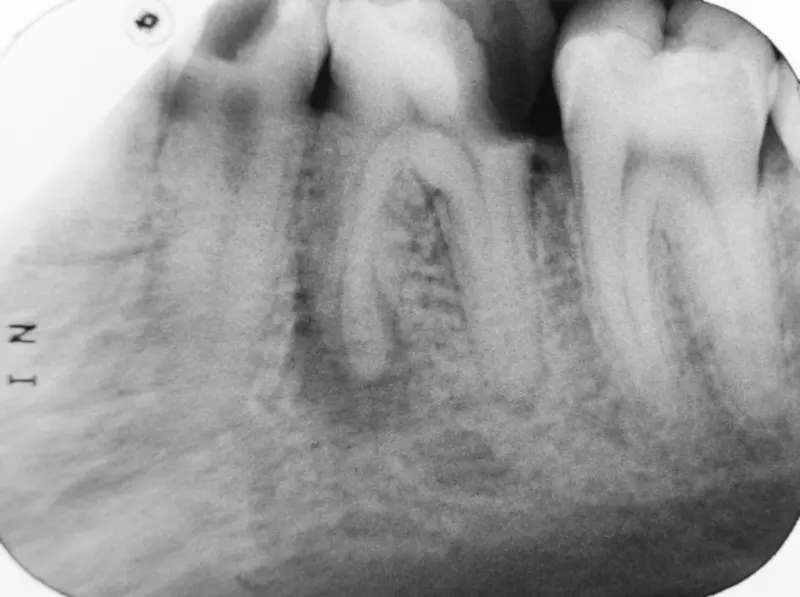
Being told you need an X-ray can feel a bit alarming, especially if you have heard that X-rays carry a risk. In fact, the radiation dose from a dental X-ray is very small, and the pictures often show problems that can't be spotted any other way.
This guide explains why X-rays are taken, the main types, how the dose compares with the natural radiation we all receive every day, and what to mention to your dental team. It is general information; your dentist will explain why they are suggesting an X-ray for you.
What X-rays show that a dentist can't see
Much of what matters in your mouth is hidden: between the teeth, under fillings, inside the roots and in the jaw bone. Guy's and St Thomas' NHS Foundation Trust explains that X-rays give information that can't be seen by looking in your mouth, and the Oral Health Foundation says that finding a problem early usually makes it easier to treat.
- Decay that isn't obvious during an examination, including decay between teeth or under the enamel.
- Infection at the tips of tooth roots.
- Bone loss around teeth caused by gum disease.
- The number and shape of a tooth's roots, and how close a tooth is to a nerve, which helps with planning treatment such as an extraction.
- The position of wisdom teeth, and in children, adult teeth still developing under the gums.
- Disease in the jaw bone, so it can be diagnosed and treated earlier.
Guy's and St Thomas': dental X-rays Oral Health Foundation: dental X-rays
The main types
The Oral Health Foundation describes several kinds of dental X-ray. Many practices now use digital X-rays, where the picture appears on a screen straight away and can be enlarged to look at detail.
- Small X-rays (bitewing or periapical): the most common type. They show a few teeth at a time, including the roots and the bone and gums around them.
- Panoramic X-ray (often called an OPG): a single wide picture of the whole mouth, showing all the teeth, both jaws, the supporting bone and the wisdom teeth.
- Medium-sized X-rays: these focus on one jaw or one side of the face.
How often you'll need them
There is no fixed schedule. The Oral Health Foundation says how often you need X-rays depends on your age, your oral health and your risk of problems: someone who gets a lot of decay or has gum disease may need them more often than someone whose mouth has stayed healthy for years.
Guy's and St Thomas' explains that a qualified member of the dental team decides on each X-ray by weighing up its benefit against any possible risk. If you are unsure why one is being suggested, it is reasonable to ask what the dentist is looking for and how it will change your treatment.
How much radiation is involved
We are all exposed to natural background radiation all the time. Guy's and St Thomas' lists some of the sources: the sun, some rocks such as granite, and even some foods, such as Brazil nuts and bananas. The UK Health Security Agency (UKHSA) gives the UK average as 2.1 millisieverts (mSv) a year.
UKHSA publishes typical doses for common X-ray examinations, with the extra lifetime risk of a fatal cancer from each one. Its figures for adults aged 16 to 69 are:
- A single bitewing X-ray: less than 0.01 mSv, the same as less than 1.5 days of natural background radiation. Extra lifetime risk: 1 in a few million.
- A panoramic X-ray: 0.01 mSv, about 1.5 days of background radiation. Extra lifetime risk: 1 in 2 million.
- For comparison, a single chest X-ray: 0.02 mSv, about 3 days of background radiation. Extra lifetime risk: 1 in a million.
Keeping the dose as low as possible
UKHSA notes that the risks for children are roughly twice those for adults, and for older people roughly a fifth. Guy's and St Thomas' says that, for legal and ethical reasons, the dose must be kept as low as possible, which is why an X-ray should only be taken when it is likely to help with your diagnosis or treatment.
The NHS describes X-rays in general as usually very safe, while noting that having many X-rays carries a very small risk that the radiation could cause cancer, which is why the risk is weighed up before one is offered. If you want to know the dose for a particular X-ray, Guy's and St Thomas' says your dental team can tell you.
If you are pregnant or might be
Always tell your dental team if you are, or might be, pregnant. Guy's and St Thomas' explains that the X-ray beam is not pointed at the developing baby, that dental X-rays are considered safe in pregnancy, and that they can be taken if they are needed for your diagnosis or treatment. The Oral Health Foundation says dentists take extra care during pregnancy and will only take an X-ray if it is essential for your care.
NHS dental treatment is free in England while you are pregnant and for 12 months after your baby is born; our post on pregnancy and your teeth has more.
What happens, and what it costs
The NHS explains that dental X-rays are usually taken in the dental surgery itself. The X-ray only takes a few minutes: you keep very still while the picture is taken, and you won't feel anything. The NHS also advises telling staff if you are pregnant or breastfeeding.
In England, X-rays that are clinically needed are included in the Band 1 NHS charge (currently £27.90), the same charge that covers a check-up. If you are having a course of NHS treatment, you shouldn't be charged separately for the X-rays it needs.
Common questions
Are dental X-rays safe?
The dose is very small. UKHSA's typical figure for a single bitewing X-ray is less than 0.01 mSv, the same as less than 1.5 days of the natural background radiation we all receive, with an extra lifetime risk of 1 in a few million. Your dentist should only take one when it is likely to help with your diagnosis or treatment.
Why does my dentist want an X-ray when my teeth feel fine?
Decay between the teeth or under fillings, infection at the root tips and bone loss from gum disease can all develop without symptoms. X-rays let your dentist find these early, when treatment is usually simpler.
Can I have a dental X-ray while pregnant?
Tell your dental team first. Guy's and St Thomas' says the beam is not pointed at the baby and dental X-rays are considered safe in pregnancy when they are needed for diagnosis or treatment; the Oral Health Foundation says dentists only take them if they are essential.
Can I say no to an X-ray?
Yes, it is your choice. Ask what the dentist is looking for and what difference it would make, because without it they may not be able to diagnose a problem or plan treatment safely.
Do I pay extra for X-rays on the NHS?
Not in England if they are clinically needed: they are included in the Band 1 charge, currently £27.90, and in the band for any course of treatment that needs them.
Sources we used
- Oral Health Foundation: Dental X-rays
- Guy's and St Thomas' NHS Foundation Trust: Dental X-rays
- UKHSA: Patient dose information
- NHS: X-ray
- NHS Business Services Authority: Help with NHS dental costs
Checked November 2026. Guidance changes, so always follow the advice of your own dental team. About our sources.