
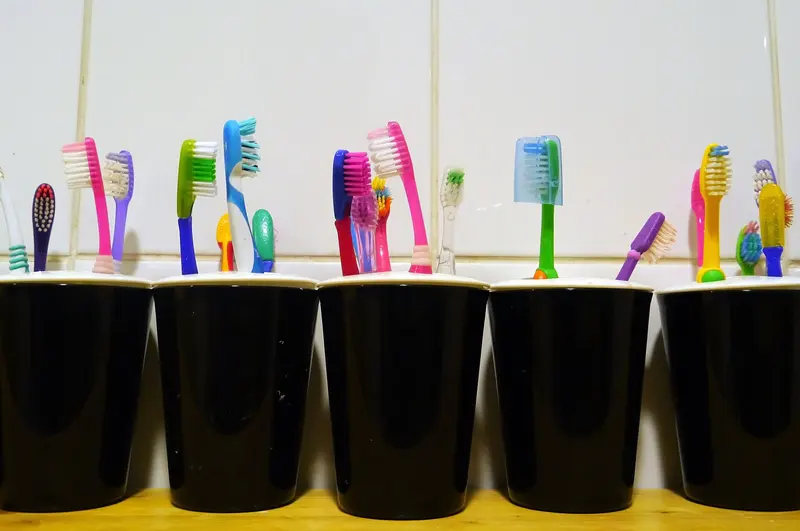
Good habits started early make a lasting difference. Tooth decay is largely preventable, and a few simple routines – twice-daily brushing with fluoride toothpaste, regular dental visits and keeping sugar to mealtimes – go a long way.
This guide follows current NHS advice. NHS dental care is free for children, so there is no cost barrier to regular check-ups.
Start brushing with the first tooth
The NHS says to start brushing as soon as the first milk tooth appears, usually around six months. Brush twice a day for about two minutes, last thing at night and at one other time. Sitting a baby on your knee with their head resting against your chest can make it easier, and letting them see you brush your own teeth helps too.
Toothpaste by age
- Up to 3 years: a smear of fluoride toothpaste containing at least 1,000ppm fluoride, unless your dentist advises a higher-strength family toothpaste. Parents or carers should do the brushing.
- 3 to 6 years: a pea-sized amount of toothpaste with 1,000 to 1,500ppm fluoride. Encourage children to brush while you supervise.
- 7 and over: toothpaste with 1,350 to 1,500ppm fluoride. Children should be able to brush on their own but it is still worth checking they do it properly.
- At every age: spit out after brushing and don't rinse, and don't let children eat or lick toothpaste from the tube.
Helping them brush well
The NHS recommends helping or supervising brushing until children are at least seven. Guide their hand so they feel the right movement, use small circular motions, brush gently along the gums and behind the teeth, and use a mirror so they can see what they are doing. An egg timer or song can make two minutes feel shorter. Don't let children walk or run around with a toothbrush in their mouth.
The first dental visit
Take your child to the dentist when their first milk teeth appear, or before their first birthday. Even just opening their mouth for a look helps them get used to the surroundings, and the dentist can spot problems early and advise on prevention. Being positive about visits yourself helps too.
Fluoride varnish and fissure sealants
From age 3, the NHS says children should be offered fluoride varnish at least twice a year; younger children may be offered it if the dentist thinks they need it. The varnish is painted on the teeth and helps strengthen enamel.
Fissure sealants – a thin protective coating on the chewing surfaces of back teeth – can be applied when the permanent back teeth come through, usually around 6 or 7, and again when the rest come through between 11 and 14. The NHS says they last up to four years.
Sugar, drinks and bedtime
The NHS says sugar causes tooth decay, and that how often and how long teeth are in contact with sugar matters as much as the amount.
- Plain milk and water are the best drinks for young children.
- From six months, offer drinks in a free-flowing cup without a valve rather than a bottle.
- If you give fruit juice, dilute it (1 part juice to 10 parts water), serve it only at mealtimes and give no more than 150ml a day.
- At bedtime and during the night, give only breast milk, formula or cooled boiled water.
- Never dip a dummy in anything sweet, and don't give honey to babies under 1.
- Ask a pharmacist or GP for sugar-free versions of medicines.
Daily sugar limits
NHS guidance on free sugars (sugars added to food and drink, plus those in honey, syrups and fruit juice) is no more than 14g a day for 2 to 3-year-olds, 19g for 4 to 6-year-olds, 24g for 7 to 10-year-olds and 30g for adults. Babies under one should not have sugar added to their food or drinks.
Accidents and braces
If a child knocks out a baby tooth, do not put it back in – it could damage the adult tooth underneath. See a dentist as soon as possible. An adult tooth, on the other hand, should be put back if possible (see our dental emergencies guide).
Braces are often free on the NHS for under-18s who need them. A dentist refers the child to an orthodontist, who assesses whether they are eligible; there may be a waiting list.
Common questions
Do children need special children's toothpaste?
No. The NHS says children can use family toothpaste with 1,350 to 1,500ppm fluoride. Children aged 3 and under without tooth decay can use a lower-strength children's toothpaste with at least 1,000ppm.
When should my child first see a dentist?
When their first milk teeth appear, or before they are 12 months old.
Until what age should I help with brushing?
Until at least seven. After that, keep an eye on whether they are brushing properly and for about two minutes.
Is fruit juice OK for children?
Only diluted, at mealtimes and no more than 150ml a day. Milk and water are the best everyday drinks for teeth.
Are sports mouthguards worth it for children?
The Oral Health Foundation recommends mouthguards for contact sports, ideally custom-made by a dentist. Children may need replacements more often as their jaws grow and adult teeth come through.
Sources we used
- NHS: Children's teeth
- NHS: Looking after your baby's teeth
- NHS: How to keep your teeth clean
- NHS: Sugar – the facts
- NHS: Knocked-out tooth
- NHS: Braces
- NHS: Who can get free NHS dental treatment
- Oral Health Foundation: Mouthguards
Checked September 2026. Guidance changes, so always follow the advice of your own dental team. About our sources.