
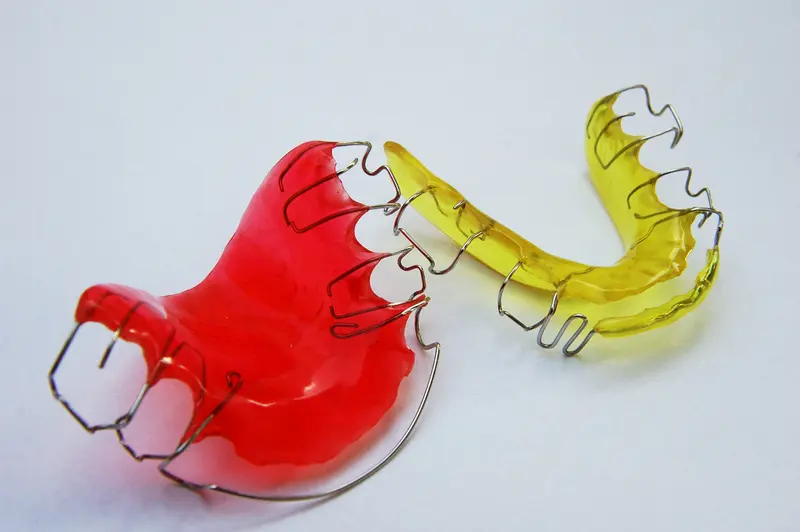
About retainers
Retainers do not move teeth; they hold them still. After braces or aligners, teeth tend to drift back towards where they started - known as relapse - and teeth also shift naturally as we age. The British Orthodontic Society says almost every orthodontic patient needs retainers, and the longer you wear them, the longer your teeth stay straight.
There are two broad types. Removable retainers include clear plastic 'vacuum-formed' retainers and Hawley retainers (a plastic plate with a wire across the front teeth). Fixed or bonded retainers are thin wires glued to the back of the teeth so they cannot be seen.
Research comparing retainer types is limited. A Cochrane review found clear plastic retainers worn part-time may allow slightly more movement than fixed retainers, though the difference may not be important, and it could not recommend one approach over another. Your orthodontist will recommend a type - sometimes more than one - based on your case.
How it works
- Your brace or aligners are removed at the end of active treatment
- Removable retainers are made from moulds or scans, or a fixed wire is bonded behind the front teeth
- Removable retainers are often worn full-time at first, then usually at night long-term
- Your orthodontist or dentist checks the retainers at follow-up visits
Time, lifespan and cost
- Time needed
- Worn from the day braces come off - typically day and night at first, then at night long term, as advised by your orthodontist.
- How long it lasts
- Retention is usually long term. Individual retainers can wear out, break or come loose and may need repair or replacement.
- On the NHS?
- Sometimes on the NHS. Retainers are part of an NHS course of orthodontic treatment for eligible patients. There may be a charge to replace a lost or broken NHS appliance - check with your orthodontist. If you had private treatment, ask what retainer replacement costs. NHS charges
Private cost
Private fees vary widely between practices and depend on the complexity of your case and the materials used, so we do not quote a typical price. Always ask for a written treatment plan with costs before you agree to treatment. (Source: British Orthodontic Society: Patient FAQs)
Pros and cons
Pros
- Protect the time and money invested in straightening
- Fixed retainers are invisible and work without you remembering to wear them
- Clear removable retainers are discreet and easy to take out for cleaning
Cons
- Removable retainers only work if you wear them as instructed
- Fixed retainers need extra cleaning and can come loose
- Hawley retainers may affect speech slightly at first
- Retainers can wear, break or be lost and need replacing
Aftercare
- Follow the wear instructions for your specific retainer exactly
- Never eat or drink anything but water with a clear removable retainer in
- Clean removable retainers as advised and store them in their case
- Take extra care cleaning around a bonded retainer with interdental brushes or floss aids
- Seek advice promptly if a fixed retainer feels loose or a removable one no longer fits
Risks and side effects
- Teeth moving if retainers are not worn or break unnoticed
- Plaque and gum inflammation around fixed retainers if not cleaned well
- Damage to teeth or gums if retainers are not used as instructed
Your dentist should explain the risks that apply to you before you agree to treatment.
Problems it can help with
Twisted, tilted or uneven teeth are very common. Here is why they happen, when they matter, and the realistic ways to straighten them.
When some upper teeth bite inside the lower teeth instead of outside. How crossbites affect the jaw and how they are corrected.
When there is not enough space for every tooth, teeth overlap and twist. Learn how crowding is assessed and the options for making room.
Gaps between teeth can be harmless, a sign of missing teeth, or occasionally a sign of gum disease. How to tell and what can close them.
When the front or side teeth do not meet even with the back teeth closed. Common causes, including habits, and what can be done.
Top teeth that stick out or overlap the bottom ones too deeply. What counts as normal, why it matters, and how braces can help.
When the lower front teeth sit in front of the upper ones. Why it happens, why early assessment matters, and the treatment options.
Common questions
How long do I need to wear a retainer?
Usually long term. The British Orthodontic Society says teeth tend to move back after treatment and continue to shift with age, so the longer you wear retainers, the longer your teeth stay straight.
Which is better, fixed or removable?
There is no clear winner. A Cochrane review found only low-certainty evidence and small differences between types. Your orthodontist may recommend one type or a combination.
What if my retainer breaks?
Contact your orthodontist or dentist promptly - teeth can start to move quickly without a retainer.
Sources we used
- British Orthodontic Society: Retainers
- British Orthodontic Society: Patient FAQs
- Cochrane Oral Health: Retention after braces
- Oral Health Foundation: Orthodontic treatment
- NHS: Braces
- NHS: How much NHS dental treatment costs
Checked September 2026. Guidance changes, so always follow the advice of your own dental team. About our sources.