
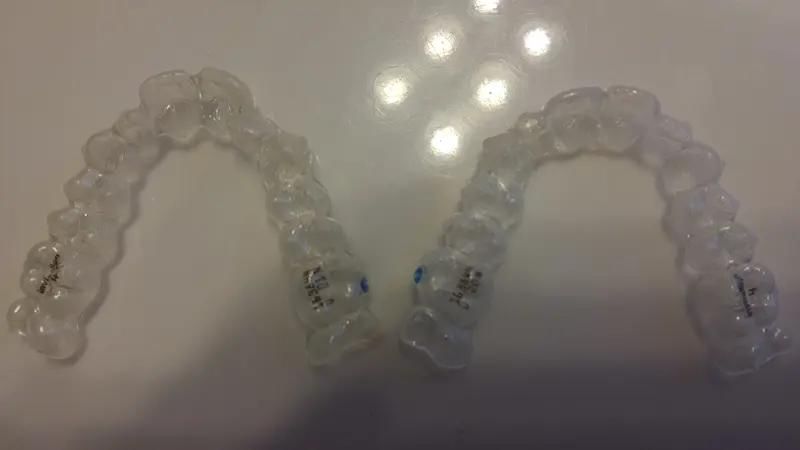
About clear aligners
Clear aligners are thin, clear, removable plastic trays that fit closely over the teeth. Each aligner in the series moves the teeth a small step towards the planned position. The British Orthodontic Society says they are most commonly used for mild to moderate crowding or spacing where no extractions are needed, and that they suit adults who find visible fixed braces difficult with their work or lifestyle.
Aligners only work while they are in your mouth, so they need to be worn full-time, day and night, apart from meal times. More complex problems - severe crowding, cases needing extractions, complicated tooth movements or problems with the jaws themselves - may need additional techniques such as fixed braces.
In the UK, orthodontic treatment with aligners is dentistry and must be prescribed by a GDC-registered dental professional. The General Dental Council says there is currently no effective substitute for a physical clinical examination before treatment, and the Oral Health Foundation warns about aligners bought online without seeing a dentist. See our guide to at-home aligners before choosing a remote service.
How it works
- Face-to-face assessment with a dentist or orthodontist, including an examination and X-rays where needed
- Impressions or a digital scan are taken and a treatment plan is made
- You receive a series of custom aligners, each worn for a set period before moving to the next
- For some crowding, the sides of certain teeth may be slightly slimmed to create space
- Regular check-ups to monitor progress
- Retainers at the end of treatment
Time, lifespan and cost
- Time needed
- Depends on the complexity of the case; orthodontic treatment in general ranges from several months to around two and a half years.
- How long it lasts
- The result needs retainers afterwards; the British Orthodontic Society says retainers will be required after any aligner treatment.
- On the NHS?
- Usually private only. Generally a private treatment. NHS orthodontic treatment for eligible under-18s most commonly uses fixed metal braces; ask your orthodontist what is available to you. NHS charges
Private cost
From £1,525 to from £4,920
'Teeth straightening' from £1,525 (mydentist myoptions, England/Wales); Invisalign from £4,136 (Bupa Dental Care Brigg) and from £4,920 (Bupa Dental Care London Bank). The right system and total cost depend on your assessment.
Published starting prices from individual practice price lists, checked September 2026. These are not averages and your quote could be higher. Sources: mydentist: myoptions private dental care price list, Bupa Dental Care Brigg: Treatment prices, Bupa Dental Care London Bank: Treatment prices.
Private orthodontic fees vary widely depending on how complex the problem is, where you live and the experience of the orthodontist, according to the British Orthodontic Society, so we do not quote a typical price. Ask for a written quotation after your consultation. (Source: British Orthodontic Society: Patient FAQs)
Pros and cons
Pros
- Nearly invisible
- Removable for eating, brushing and cleaning between teeth
- No brackets or wires to break or rub
- Well suited to mild to moderate crowding and spacing in adults
Cons
- Only work if worn nearly all day and night - it relies on you
- Less effective for severe or complex problems, and jaw-related bite problems
- Easy to lose or damage when taken out
- Usually private-only
- Remote 'direct-to-consumer' services may skip the in-person checks that make treatment safe
Aftercare
- Wear the aligners full-time except when eating and drinking anything other than water
- Keep your teeth and aligners clean as your provider advises
- Clean the aligners as your provider advises and keep them in their case when out
- Attend every monitoring appointment and see your own dentist for check-ups
Risks and side effects
- Teeth moving less than planned if the aligners are not worn enough
- Tooth sensitivity, tooth decay, inflamed gums and jaw ache, which are among the most common issues during orthodontic treatment
- Relapse without retainers
- With unsupervised treatment: undetected gum disease or bone loss, which the Oral Health Foundation warns could lead to loosened teeth
Your dentist should explain the risks that apply to you before you agree to treatment.
Problems it can help with
Twisted, tilted or uneven teeth are very common. Here is why they happen, when they matter, and the realistic ways to straighten them.
When some upper teeth bite inside the lower teeth instead of outside. How crossbites affect the jaw and how they are corrected.
When there is not enough space for every tooth, teeth overlap and twist. Learn how crowding is assessed and the options for making room.
Gaps between teeth can be harmless, a sign of missing teeth, or occasionally a sign of gum disease. How to tell and what can close them.
When the front or side teeth do not meet even with the back teeth closed. Common causes, including habits, and what can be done.
Top teeth that stick out or overlap the bottom ones too deeply. What counts as normal, why it matters, and how braces can help.
When the lower front teeth sit in front of the upper ones. Why it happens, why early assessment matters, and the treatment options.
Compare it with the alternatives
Braces vs clear aligners
Fixed braces and clear aligners compared on visibility, what they can fix, comfort, cleaning, NHS…
Common questions
Are aligners as good as fixed braces?
For mild to moderate problems they can work well. The British Orthodontic Society says severe crowding, extraction cases, complex movements and jaw-related problems may need other techniques such as fixed braces.
Is it safe to buy aligners online?
Be cautious. The General Dental Council says a physical examination is currently essential before orthodontic treatment, that you must know the name of the dentist responsible and be able to contact them. The Oral Health Foundation warns that home impression kits and shop scans cannot take X-rays or check the health of your gums and bone.
How many hours a day do I need to wear them?
The British Orthodontic Society says aligners need to be worn full-time, day and night, except at meal times. Your provider will give you specific instructions.
Will I need a retainer afterwards?
Almost certainly. The British Orthodontic Society says nearly every patient needs retainers after braces, and that you should only start treatment if you are happy to wear them to keep the result.
Sources we used
- British Orthodontic Society: Clear aligners
- British Orthodontic Society: Patient FAQs
- Oral Health Foundation: Orthodontic treatment
- Oral Health Foundation: Safe Smiles: the dangers of DIY orthodontics
- General Dental Council: Aligners or braces sent directly to your home
- General Dental Council: Statement on direct-to-consumer orthodontics
- British Orthodontic Society: Retainers
- mydentist: myoptions private dental care price list
- Bupa Dental Care Brigg: Treatment prices
- Bupa Dental Care London Bank: Treatment prices
Checked September 2026. Guidance changes, so always follow the advice of your own dental team. About our sources.